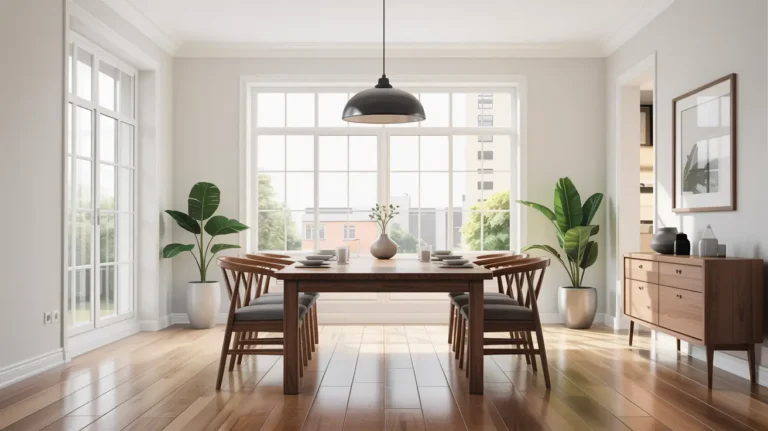

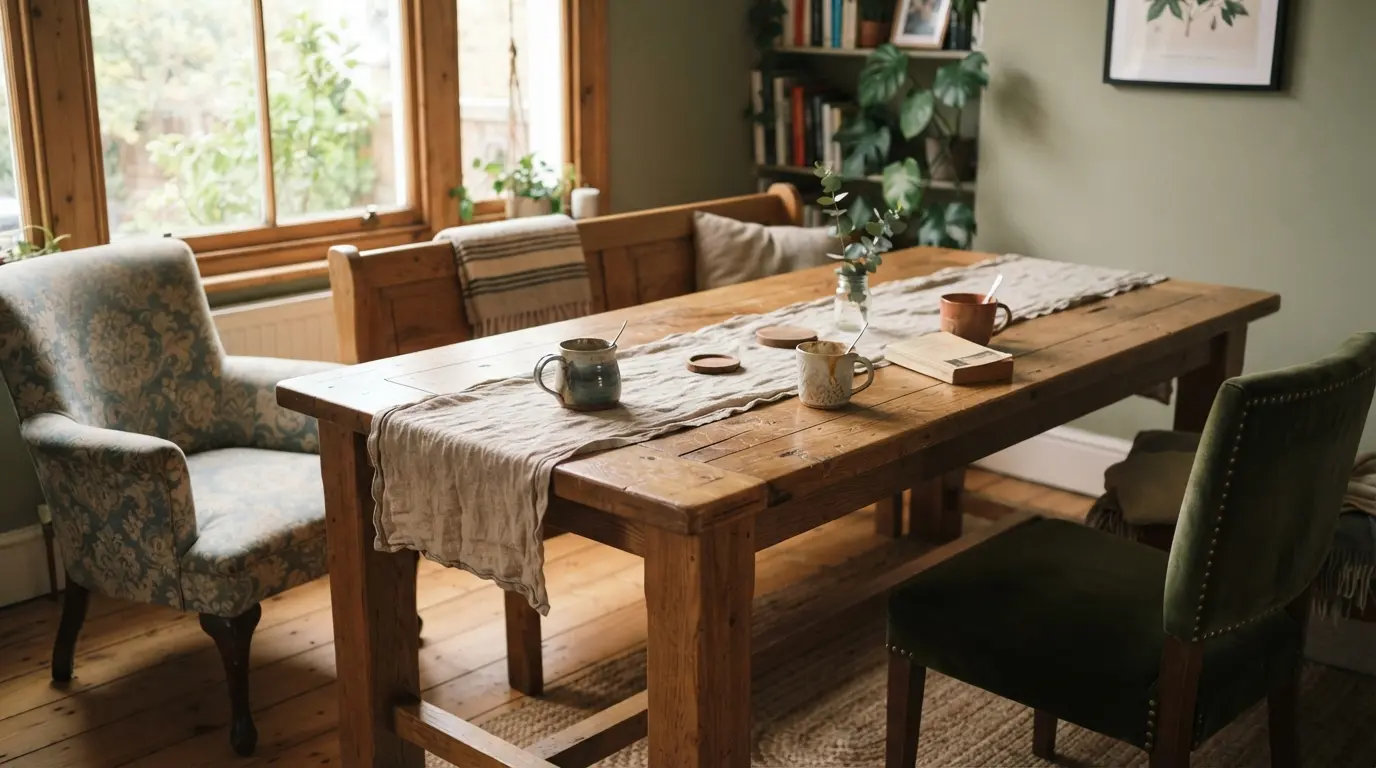
Swap one or both sides of dining chairs for a bench and you get more seats in less floor space, plus a room that reads as relaxed rather than showroom-perfect. The trick is matching bench height to your existing table and choosing a length that leaves room to pull it out. Get those two details wrong and the whole look falls apart.
The thing most people worry about before making the swap isn’t the look, it’s whether it will actually work day to day. Will a bench feel like a school canteen seat by the third course? Will it look like an afterthought next to a table that was designed around chairs? Fifteen years of specifying dining furniture for clients has taught me it comes down to a handful of measurements and one styling decision, not luck.
Why Swap Dining Chairs for a Bench?
A bench beats chairs on flexibility and floor space. It seats two to three adults in the width four chairs would need, slides fully under the table when not in use, and lets you squeeze in an extra guest at short notice without dragging a chair from another room.
Chairs still win on individual comfort and formality, which is exactly why mixing the two rather than going all-bench is usually the better call for most households. A dining table with bench and chairs gives you a defined “head” end with proper back support, and a casual, communal side for everyday meals, kids, or overflow seating when people visit.
This mixed approach works particularly well if your dining space does double duty. Open-plan kitchen-diners, small breakfast nooks, and rooms where the table also becomes a homework or laptop station all benefit from a bench’s ability to disappear against the wall between uses.
Getting the Sizing Right: Bench Height, Length, and Clearance
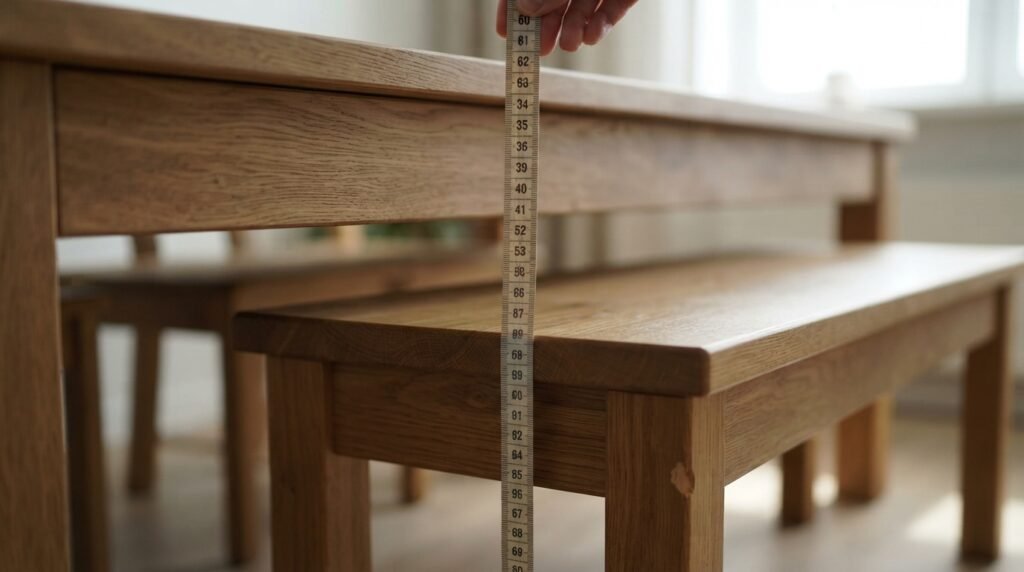
Before anything else, measure. A bench that’s the wrong height or length is the single biggest reason this swap looks off, and it’s the mistake I see most often when people buy a bench that “roughly” matches rather than actually matches.
Start with seat height. Most dining chairs sit between 45 and 48cm from the floor to the top of the seat, so your bench needs to land in that same range, ideally within a centimetre or two. A bench that’s noticeably lower than the chairs beside it looks like a mismatch even if nobody can say exactly why.
Next, check clearance. You need at least 28 to 30cm between the underside of the tabletop apron and the top of the bench seat, so knees and thighs aren’t jammed against the frame. Tables with a deep skirt or a central stretcher bar often fail this test, so measure before you buy rather than after.
Finally, length. A bench that runs the exact same length as the table edge looks neat in photos but is a pain in real life, because people can’t slide it out without catching the table legs. Leave a gap of roughly 10 to 15cm at each end, or size the bench to seat one fewer person than the space technically allows. It’s a small sacrifice that makes the seat genuinely usable.
| Feature | Dining Bench | Dining Chairs |
| Floor space per seat | Low, slides under table | Moderate to high |
| Seats added per piece | 2-3 per bench | 1 per chair |
| Individual back support | Only with a backed bench | Standard |
| Flexibility for extra guests | High, easy to seat more | Low, needs spare chairs |
| Visual formality | Casual | Formal to semi-formal |
| Replacing one damaged seat | Whole bench affected | Swap a single chair |
Where to Put the Bench: One Side, Both Sides, or a Corner
The most common and easiest layout is a bench on one long side with chairs on the other and at the ends. It keeps the table looking anchored, gives you a formal side for guests and a casual side for family, and works with almost any table shape except a small round one.
Pushing the bench against a wall is the better choice if floor space or traffic flow is tight, since it removes the need for chair-pulling clearance on that side entirely. If the table sits in the open, away from a wall, a bench still works but loses some of its space-saving advantage because you still need room to walk around it.
For small dining rooms or breakfast nooks, an L-shaped or corner bench arrangement, sometimes called a banquette when it’s built in, can outperform a straight bench because it wraps two sides of the table and frees up the rest of the room. This only suits smaller, more casual settings though. In a formal dining room a fixed corner seat tends to read as dated rather than intentional, because it breaks the symmetry that formal dining depends on.
Should the Bench Match Your Chairs?
No, and trying to match it exactly is usually where the look goes wrong. A good rule of thumb is to repeat one detail, the wood tone, the leg shape, or the colour palette, and let everything else contrast. That single shared thread is what stops the room from looking like leftover furniture pushed together.
A safe starting combination is a solid wood bench in the same tone as the table, paired with upholstered or woven chairs in a complementary but different material. This gives you the textural contrast that makes mixed seating feel designed rather than accidental, without the bench and chairs fighting for attention.
Where this goes wrong in practice is pairing pieces with very different visual weight, a chunky farmhouse bench with delicate metal-framed chairs, or an oversized upholstered bench with slim dining chairs. Neither looks intentional. Keep the bench and chairs in the same rough scale as each other and as the table, and the contrast in material or colour reads as a choice rather than a mistake.
Bench Styles and Materials for Different Dining Looks
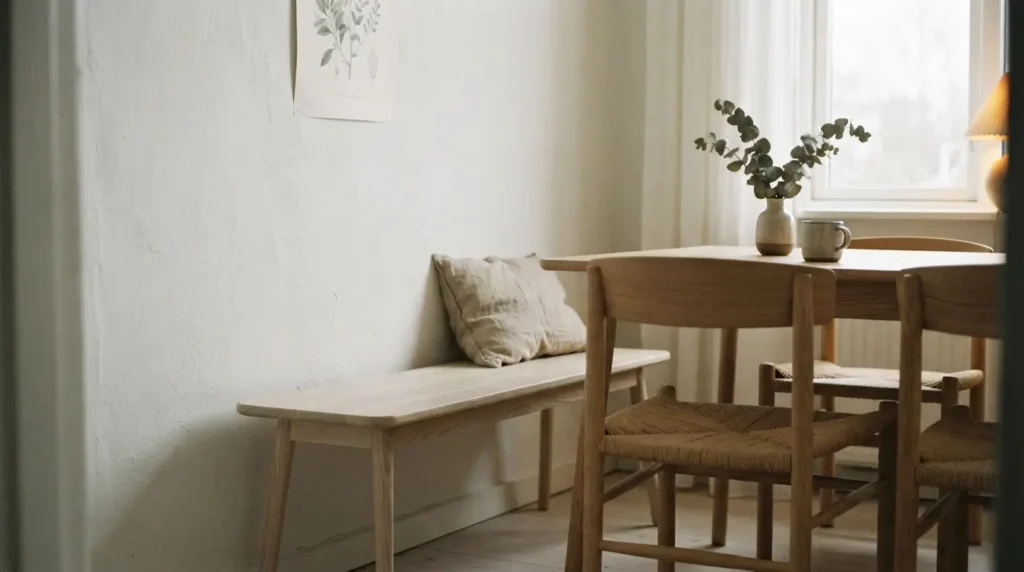
Farmhouse: A solid oak or reclaimed timber bench with turned or trestle legs pairs naturally with spindle-back or ladder-back chairs. This is the most forgiving style combination for a first attempt at mixed seating.
Scandinavian: Pale ash or birch, slim tapered legs, and minimal detailing keep the look light and airy. Add a linen or wool seat pad rather than a fully upholstered bench to keep the silhouette clean.
Industrial: A metal-framed bench with a reclaimed wood or engineered timber top works well against a darker table and mixed metal-and-wood chairs. Keep the palette tight (black, raw steel, warm oak) so the contrast doesn’t tip into clutter.
Modern organic and contemporary: Upholstered bouclé, boucle-look weaves, or performance fabric benches with a soft, curved silhouette are having a real moment right now, especially paired with ceramic or marble-effect tabletops. It’s a look that photographs beautifully but needs a fabric that can handle daily use, which is covered below.
Transitional: Borrow from two or three of the above rather than committing fully to one, a wood bench with upholstered chairs, or vice versa. This is the most flexible option if your dining room needs to work with furniture you already own.
Cost Comparison: Bench vs a Full Set of Dining Chairs
Cost is one of the genuine reasons people make this swap, and the saving is real, though it isn’t quite as simple as “one bench costs less than four chairs.”
| Seating Option | Typical Price Range (approx.) | Seats |
| Basic solid wood bench | £80-£220 | 2-3 |
| Upholstered bench | £150-£450 | 2-3 |
| Two mid-range dining chairs | £120-£350 | 2 |
| Set of four mid-range dining chairs | £240-£700 | 4 |
These figures are approximate and vary a good deal by country, material, and retailer, so treat them as a starting point for budgeting rather than a fixed number. In most projects I’ve worked on, a bench does end up cheaper per seat than an equivalent number of chairs, and it’s one item to source, deliver, and eventually reupholster instead of four or six.
The trade-off worth knowing before you buy: if one chair in a set gets damaged, you replace or repair that single chair. If a bench gets scratched or the upholstery wears through, the whole piece needs attention, and matching a single replacement bench years later is harder than matching one chair from a set that’s still in production.
Living With a Bench: Comfort, Maintenance, and Mistakes to Avoid
A backless bench is genuinely comfortable for everyday meals under about an hour. For longer dinners, holiday meals, or anyone hosting regularly, either choose a bench with a low backrest or plan to add cushions, because most adults start shifting and slouching without back support well before dessert.
Upholstered benches look wonderful in photos but need an honest look at the fabric before you commit. Bouclé and velvet are on-trend right now and feel lovely, but they’re not the easiest to spot-clean around young children, red wine, or pets. A performance weave or a removable, washable cover does the same job with far less maintenance stress, even if it’s a slightly less glamorous fabric name.
Wood benches need the same care as your table, regular dusting, coasters or mats under hot dishes, and a wipe rather than a soak if something spills. What catches people out is placing an unprotected wood bench on a hard floor without felt pads, which scratches both the bench legs and the floor within months of daily sliding in and out.
The most common styling mistake, beyond the sizing issues covered earlier, is treating the bench as an afterthought rather than a considered piece. A bench bought purely because it was cheap, in a finish that doesn’t relate to anything else in the room, tends to look exactly like what it is. Choose it with the same care as you’d choose a chair, and the room reads as a design decision instead of a compromise.
Can You Use a Bench With a Round or Oval Table?
Yes with an oval or larger round table, but it takes more planning than a rectangular one. A straight-edged bench sits naturally against one flattish side of an oval table, so this pairing works well. On a true round table, the curve rarely lines up cleanly with a straight bench edge, and most people find a small round table looks better served entirely by chairs, or by a curved banquette if the space allows for a custom build.
Conclusion
The short version: measure your seat height and clearance before you buy, leave room at the ends of the table for the bench to slide out, and pick one shared detail to tie the bench to your existing chairs rather than trying to match everything. Once those basics are sorted, using a dining bench instead of chairs is one of the lowest-effort ways to make a dining room feel less formal and more lived-in without replacing the table at all. Start with the sizing, then have fun with the styling; that order matters more than which fabric or wood tone you land on.
FAQs
Is it OK to use a bench instead of chairs at a dining table?
Yes. Using a bench on one full side of the table, with chairs on the other side and ends, is one of the most common and easiest layouts to get right, and it works in nearly any dining style from farmhouse to modern.
Do benches need to match the dining chairs?
No. Repeating a single shared detail, such as wood tone or colour, gives the room enough visual connection while still letting the bench and chairs contrast in shape and material.
What size bench do I need for my table?
Match the bench seat height to your chair height (usually 45-48cm), and leave 10-15cm of space at each end of the table edge so the bench can be pulled out without hitting the table legs.
Are dining benches comfortable for long dinners?
A backless bench is fine for everyday meals but tends to get uncomfortable over long dinners. A backed or well-cushioned bench solves this if you host regularly.
Can I use a bench with a round table?
It works best with oval tables, where the bench sits against a flatter side. True round tables are usually better suited to chairs alone.
Should the bench go against the wall or on the open side?
Against the wall if you’re short on floor space or need clear traffic flow. On the open side if the table isn’t near a wall or if you want a fully mixed seating look on both sides.
How do I stop a bench from scratching my floor?
Fit felt or rubber pads under each leg and check them periodically, since a bench that gets pulled in and out daily wears pads down faster than a chair that’s lifted rather than dragged.